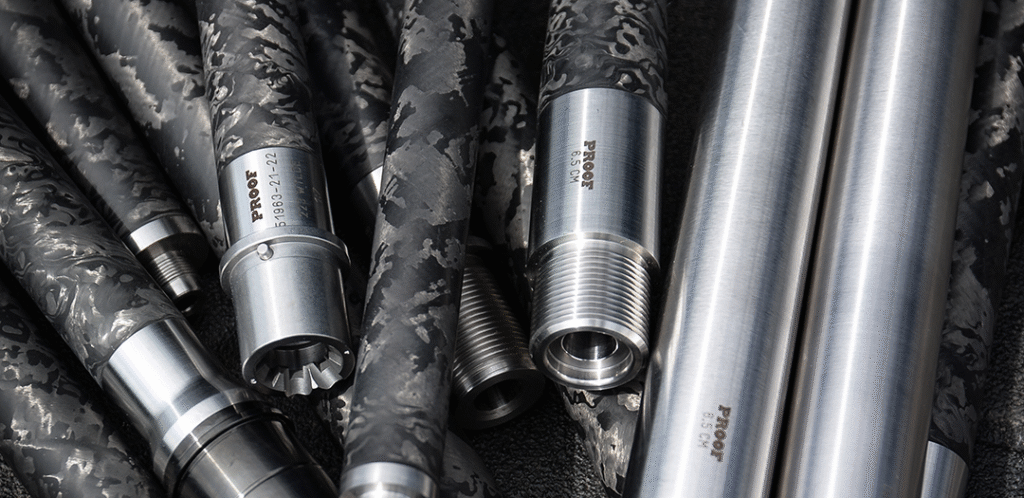
When picking a barrel for your build/caliber, three things matter most: Length, Twist Rate, and Contour. The “right” choice depends on your platform, the cartridges and bullets you plan to run, and how you intend to use the rifle.
Barrel length primarily affects muzzle velocity, not inherent precision. Shorter barrels aren’t automatically less accurate — in fact, a shorter, stiffer barrel can be very consistent. Expect roughly ~25 fps per inch of length on average (so a 28″ barrel will often be about 100 fps faster than a 24″ barrel).
Keep in mind: extra length adds weight and overall length. For carbon barrels, plan on about 2.5 oz per 2″ of added barrel length (rough guideline). Choose the length that balances the velocity you want with the handling you need for your mission.
Twist rate is how many inches it takes a bullet to make one rotation (1:9 = one turn in 9″). Faster twists (lower number) stabilize heavier, longer bullets. The simplest way to confirm stability is with a ballistics/stability calculator.
General guidance by caliber:
If you plan to push into very heavy bullets for a given caliber, choose a faster twist (lower ratio). If you want the broadest compatibility across common bullets, pick a mid-range twist that suits the majority of loads you’ll use.
Contour affects weight and stiffness, and should match your goals and stock/channel limitations. With PROOF carbon barrels you’ll commonly choose between Sendero Light, Sendero, and Bull contours:
If lengths are equal, the Sendero typically weighs about 2.5 oz more than the Sendero Light and provides increased stiffness that tends to favor precision. Our general recommendation is to look into the Sendero unless you’re constrained by stock channel size, going under ~22″, or absolutely need the lightest possible rifle.
Fitment note: PROOF contours can be larger than factory barrels. If you’re replacing a factory barrel, confirm your stock’s channel. Our website has engineer drawings with dimensions for all contours. This offers a great reference point when looking at stock fitment. Many of the popular aftermarket stocks know our contours and have barrel inlets catered specific to that contour (PROOF Sendero). Some stocks will need modification or replacement to accept a larger contour — your gunsmith can advise.
We also offer steel barrels across a range of contours for shooters who prefer traditional profiles:
There’s no single “best” barrel for everyone. Platform, intended use, and personal preference frequently determine the right tradeoffs. A mountain hunter will pick differently than a precision rifle competitor.
If you’re wondering whether to buy a pre-fit or a barrel blank, this will clear it up.
Our pre-fit barrels are finished, chambered, threaded, and ready to install on specific platforms and actions. Think of them as “plug-and-play”. They’re ideal if we list a pre-fit for your action, desired caliber, and twist — fast, reliable, and out-of-the-box ready.
Bottom line: If your action/platform is listed in our pre-fit lineup, a pre-fit is the quickest, most straightforward option.
A barrel blank is a true blank canvas — it’s a fully turned and finished barrel blank that is not chambered or threaded. Blanks are always a great option to use blanks when:
Blanks give you total flexibility, but they require a skilled gunsmith to chamber, thread, fit, and finish.
We get this question a lot. A factory Remington 700 (and several other factory actions) does not accept a universal, one-size-fits-all pre-fit because of variance in tolerance from action to action. That doesn’t mean you’re out of luck — it just means a gunsmith will typically use a barrel blank to build a correct fit for your exact action.